Perimeter
The Dog StarsThe Perimeter is the defended landscape around Erie airfield, the practical foundation of Hig and Bangley’s survival partnership and the ground on which their opposing beliefs about strangers meet. It extends across open country toward the mountain front: Hig’s task is to watch and patrol it from the air, while Bangley provides the firepower to defend it. Yet the boundary cannot settle the question of whom it protects. Hig sees a landscape to be read and shared; Bangley sees one that must be secured before danger can arrive.
Definition and Geography
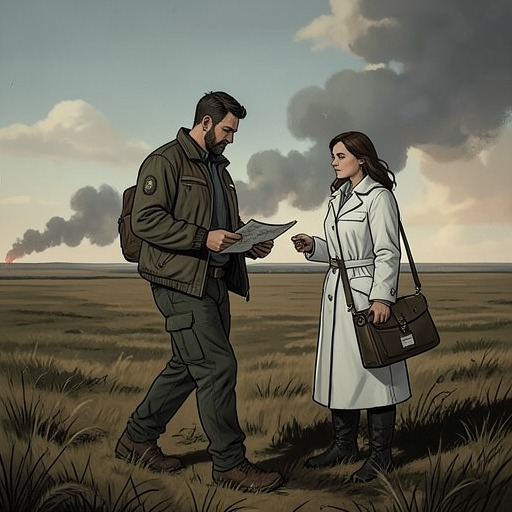
Hig describes eight miles of open ground between their position and the mountain front, where the first trees begin. That stretch is their safety zone, and maintaining it is his job. The terrain is not empty in any simple sense: old farmsteads, sage, creekside willows, and arroyos with undercut banks could conceal someone. Bangley has asked how Hig can know that no one is hiding there, waiting to attack. Hig’s answer is confidence in close observation. He knows the country as a book read repeatedly, and believes he would notice a sentence out of place or a gap in its familiar pattern.
That confidence coexists with a clear awareness of exposure. Hig thinks he could die on a mountain trip, crossing open ground with a loaded sled and vulnerable to an attack from behind. Bangley has given him a bullet-resistant vest that can stop a handgun round or an arrow, though a rifle remains a matter of luck. Hig wears the vest partly for warmth, but in summer often leaves it off; when he wears it, he feels as if he is waiting for something that may never come. The Perimeter is therefore not an impenetrable wall. It is a zone that must be watched, crossed, and trusted without ever becoming completely safe.
Patrol, Firepower, and the Tower
The partnership’s division of labor began in a confrontation over Jasper. When Jasper snapped at Bangley, Bangley drew a large sidearm. Hig stopped the escalation by explaining that he flew patrols, the only way they knew to secure the Perimeter. Bangley understood the practical force of that argument. Their bargain followed without formal negotiation: Hig flew, Bangley killed, and they learned to let each other be. The arrangement makes each man’s work necessary to the other’s defense, even where their temperaments and judgments remain distinct.
They also built a separate tower four miles out onto the plain, halfway toward the mountain front. Erie airfield had no control tower; pilots ordinarily communicated with one another and relied on established protocol. Their structure served a different purpose. They spent two months building it from salvaged lumber taken apart from a blocky wooden building on Piper Lane, transporting the material in Bangley’s pickup and dry van trailer. A generator salvaged from a hangar powered the saws and drills. Bangley designed the bench rest and locking swivel for the top platform, as well as mounts for a spotting scope and laser range finder. He did not leave those weapons and instruments there, but a wind indicator remained on its own pole, and Bangley’s ballistics tables sat in a drawer Hig made.
Bangley’s preferred firing range was fourteen hundred yards: close enough, given his skill, to make a kill likely, but far enough to satisfy his pride. A point on Hig and Jasper’s long-used trail became the consequence of that system. Hig describes the ground there as stained by the blood of people who had seen their last view of the world at that spot. The tower thus makes the Perimeter more than a warning line or lookout. It gives Bangley a distant field of fire, while the familiar path through the country bears the human cost of defending it.
People Inside and Beyond the Boundary
The surrounding country complicates any claim that Hig and Bangley are alone. Roughly ten miles to the south is a Mennonite community of about thirty people. Its members have a blood disease that appeared after the flu; children were born with it, and some die each year. Hig likens the illness to AIDS but is unsure of its nature or contagiousness. The community does not bother the two men, yet its presence means that the defended landscape exists among other survivors, not outside human society altogether.
Bangley’s strategic outlook emphasizes the west, where the mountain front is only a couple of hours away on foot, while high plains extend for thirty miles in the other directions and would take more than a day to cross. Hig, meanwhile, pays attention to possible visitors and to the lives beyond the defended ground. In one encounter he tells a man he will not kill him, while making clear that the man must leave without speaking. The episode shows that enforcement need not always end in immediate death, but it remains an exercise of control backed by force.
Security and Moral Division
The Perimeter is also the point where the two men’s principles divide. Bangley’s rule is to treat an unknown visitor as guilty and act before the visitor can become a danger. Hig’s opposing instinct is to let someone remain alive long enough to show whether he is human and trustworthy. Hig believes that Bangley’s principle, pursued to its conclusion, leads to solitude: a world in which everyone is for himself and even protection becomes a reason to kill. He associates the alternative with fragile acts of connection, including help requested and given, a smile across a yard, or a wave.
Bangley argues that their position is the safest place they could have: it has the Perimeter, water, power, food, firepower, nearby mountains where they can hunt if game becomes scarce, and no internal politics because only the two of them live there. Hig’s role in maintaining security does not erase his reservations about the terms of that safety. The system depends on the cooperation of two people, but it cannot settle their disagreement over how to treat everyone else. The Perimeter is at once their shared protection and the boundary of their ethical conflict.